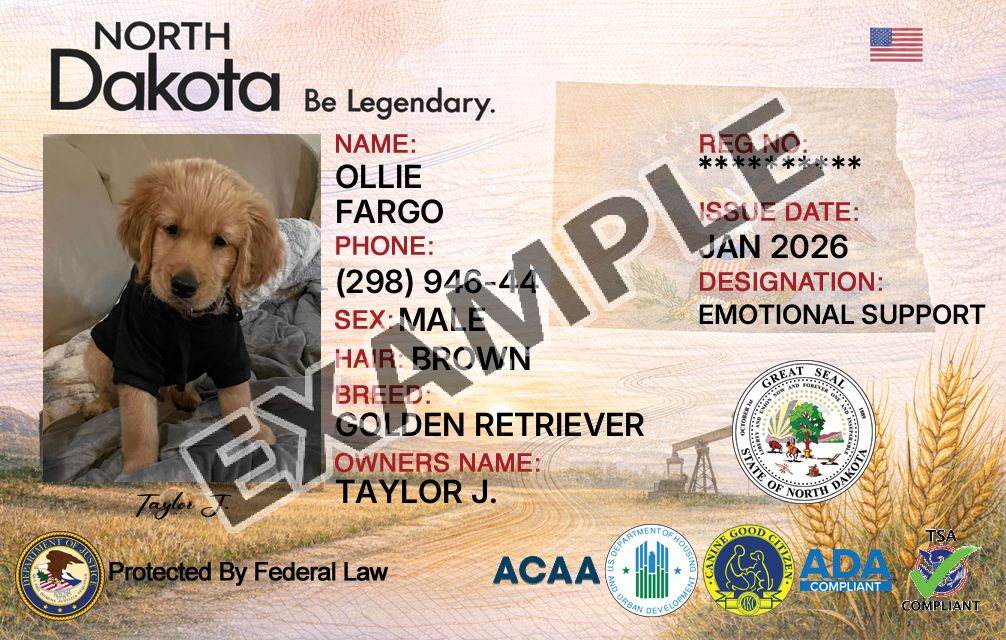
If you’re searching where do I register my dog in Ward County, North Dakota for my service dog or emotional support dog, the key thing to know is this: dog registration (licensing) is usually handled locally—most often by the city you live in (like Minot, Burlington, Sawyer, or Surrey), not by a single countywide “service dog registry.”
This page explains how a dog license in Ward County, North Dakota typically works, where to start, what documents you may need (especially rabies vaccination proof), and the important legal difference between a municipal dog license, a service dog, and an emotional support animal (ESA).
Where to Register or License Your Dog in Ward County, North Dakota
Because licensing is often managed at the city level, below are several examples of official offices within Ward County, North Dakota that residents commonly contact for licensing, animal control, or related enforcement. If you’re not sure which office applies to your address, start with the city office where you live (or the nearest city office if you’re just outside city limits).
Ward County Auditor / Treasurer’s Office (County Administration)
Note: Ward County’s Auditor/Treasurer office is an official county contact point for permits and administrative services. Dog licensing itself is commonly handled by cities; use this office if you need direction for the right local authority.
City of Minot Animal Control (Enforcement & Guidance)
The City of Minot ordinance requires licensing for dogs six months or older, and licensing is tied to proof of vaccinations (including rabies).
Souris Valley Animal Shelter (Local Shelter Resource)
While shelters are not always the legal licensing authority, they can be a practical starting point to confirm local procedures—especially in and around Minot.
City of Burlington (City Hall)
City of Sawyer (City Auditor)
Tip: Many small cities handle pet licensing through the city auditor/clerk. Ask whether your household address falls inside Sawyer city limits and whether a city pet tag is required.
Overview of Dog Licensing in Ward County, North Dakota
What “registering your dog” usually means
When most residents ask “where do I register my dog,” they mean getting a local dog license (sometimes called a pet license or city tag). A license is a local government record that links your dog to you and helps support animal control services, lost-and-found reunification, and rabies enforcement. In many parts of Ward County, North Dakota, the main licensing authority is the city you live in—especially in larger jurisdictions like Minot.
Rabies vaccination is a common licensing prerequisite
A current rabies vaccination is one of the most common requirements to receive a local pet license. For example, Minot’s licensing process references proof of vaccinations before a license is issued, and local ordinances may specify a timeframe for acceptable rabies inoculation. At the state level, North Dakota animal health guidance also emphasizes rabies vaccination standards for dogs (including timing and vaccine specifications).
Licensing vs. “registration” for service dogs and ESAs
A dog license in Ward County, North Dakota is different from a dog’s status as a service animal or emotional support animal. A city license is a local requirement that may apply to most dogs within city limits. Service dog status is based on disability law and training/handler need—not a city tag. ESAs are primarily recognized in housing contexts and do not have the same public access rights as service dogs.
How Dog Licensing Works Locally in Ward County, North Dakota
Step 1: Determine your local licensing authority
Start by identifying where you live:
- Inside Minot city limits: you typically follow City of Minot rules and contact City Animal Control for guidance. Licensing may be available through approved local points of issuance and is tied to vaccination proof.
- Inside another Ward County city (example: Burlington, Sawyer): contact that city’s auditor/clerk or city hall to ask about pet licensing.
- Outside city limits (county rural address): requirements can be different. Start with Ward County administration or your nearest city office to confirm the correct process.
Step 2: Prepare required documents (rabies proof matters)
Even when fees and renewal dates differ by city, most offices will ask for:
- Rabies vaccination certificate from a veterinarian (often required before issuing a tag)
- Owner identification
- Proof of address/residency (especially if you are new to the area)
- Payment for the licensing fee (amount varies by local ordinance)
Step 3: Get a tag and keep it current
A city license generally comes with a numbered tag. Keep the tag attached to your dog’s collar when your dog is in public. This is especially helpful if your dog is found as a stray, and it supports quick return-to-owner efforts.
What “animal control dog license Ward County, North Dakota” can mean
People often search the phrase animal control dog license Ward County, North Dakota expecting a single county office. In reality, “animal control” and “licensing” duties may be split:
- City animal control focuses on enforcement, complaints, and municipal ordinance compliance.
- City hall/auditor/clerk or designated issuance locations handle the administrative step of issuing licenses/tags.
- County administration may direct residents to the correct local authority, especially for rural addresses.
Service Dog Laws in Ward County, North Dakota
Service dog status is legal status, not a license category
A service dog is generally defined (under disability law) as a dog trained to perform specific tasks for a person with a disability. The dog’s “service” status comes from the dog’s training and the handler’s disability-related need—not from purchasing a vest, completing an online certificate, or registering in a private database.
Do service dogs still need a city pet license?
Often, yes—service dogs may still need to comply with local public health rules like rabies vaccination and licensing if the city requires it. However, local ordinances can include exemptions for certain categories (for example, some city codes exempt certain government service dogs from licensing requirements). The best approach is to ask your local licensing office whether an exemption applies to your situation and what documentation (if any) they accept.
Public access vs. licensing paperwork
Public access questions (bringing your service dog into places where pets typically aren’t allowed) are separate from getting a dog license. A local pet license is primarily about identification, compliance, and rabies enforcement. If you’re licensing a working service dog, you may still be asked for the same vaccination proof as other dogs.
Emotional Support Animal Rules in Ward County, North Dakota
An ESA is not the same as a service dog
An emotional support animal (ESA) provides comfort by its presence, but it is not trained to perform specific disability-related tasks in the way a service dog is. ESAs generally do not have the same public access rights as service dogs.
Where ESAs are commonly recognized: housing
ESA requests most often come up in housing situations (for example, requesting a reasonable accommodation for an animal in a property with pet restrictions). Even if your dog is an ESA, a city may still require standard licensing and rabies vaccination compliance if you live inside city limits.
Avoid confusing “ESA registration” with licensing
If you are trying to figure out where to register a dog in Ward County, North Dakota for ESA purposes, focus first on obtaining the correct local dog license required by your city (if applicable). “ESA registration” sold online is not the same thing as a municipal license and is not typically required by government agencies.